.png)
NM Supreme court rejects Project Jupiter bid to vacate stay. Also, PRC admits it doesn't understand the law governing mergers right after approving the buyout of NM Gas Company.
Breaking news - today Project Jupiter's bid to lift the NM Supreme Court's stay on the air quality permit proceeding was DENIED. Evidently the Justices were unmoved by their false insistence that the permit deadline is set in stone, or that the other parties in the case should be forced to proceed with submitting testimony when discovery and due process were denied. The Air Permit hearing remains on hold pending the NM Supreme Court's decision on our Writ of Mandamus request.
Now onto another case. Remember when protestors asked if the PRC will uphold the law? Apparently the Commissioners don't actually understand it.

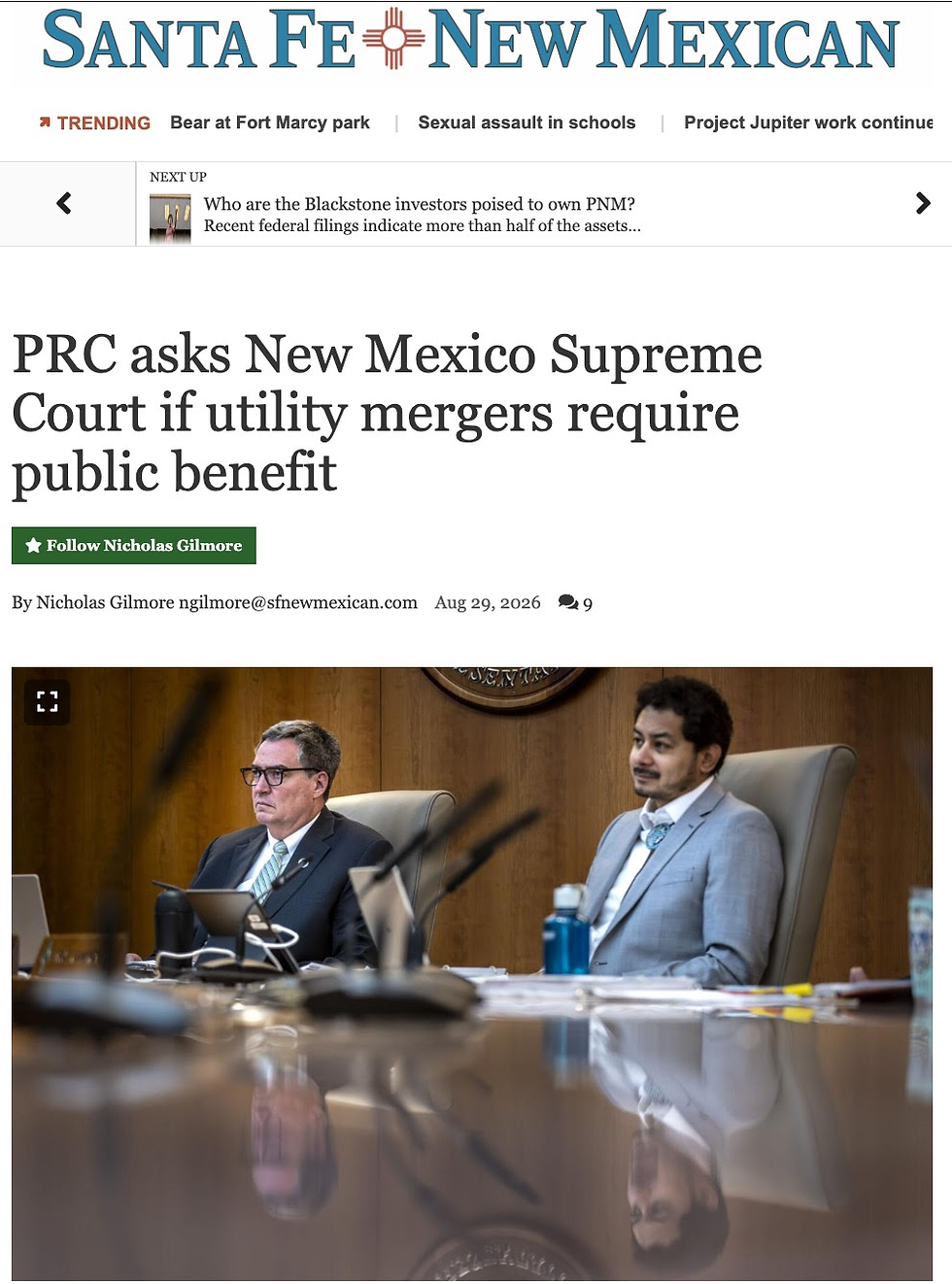
You may recall that New Energy Economy appealed the PRC's July decision to approved the Bernhard Capital Partners purchase of NM Gas Company to the NM Supreme Court. On August 18th the PRC filed an extraordinary motion in that case, asking the New Mexico Supreme Court to issue an advisory opinion clarifying the legal framework governing acquisitions of utilities, or in the alternative, to expedite their decision on our BCP appeal because of the pending Blackstone case.
The motion from the PRC poses an absurd question. They write "Before determining whether a proposed acquisition satisfies the applicable legal standard, the Commission must know what that standard is." That's quite an admission! New Energy Economy's response on Friday last week argues that the PRC should have been clear about the legal standard before it decided the BCP case. That is the basic job of a regulator.
The question in this case is not what the law is. The question is whether the Commission followed the law when it approved this takeover.
For nearly three decades the PRC has evaluated utility acquisitions under a public-interest framework that examines whether customers receive affirmative benefits and whether those benefits outweigh the transaction’s risks. The Commission’s established Six-Factor Analysis examines customer benefits, preservation of Commission jurisdiction, service quality, improper subsidization of non-utility activities, the qualifications and financial health of the proposed new owner, and protections against harm to customers.
Now, after approving the acquisition of NM Gas Company, the Commission has asked the Supreme Court for “more certainty and clarity” about the legal framework governing utility acquisitions.
Commissioners Patrick O’Connell and Greg Nibert articulated a dramatically different standard when they voted to approve the BCP acquisition, with Chairman O’Connell stating during the July 30th meeting that “the merger standard is continuation of service.”
The law governing mergers was there before the hearing. Thirty years of precedent was there before the hearing. The parties spent more than a year presenting testimony and evidence under that established standard. The PRC cannot change the rules after the game is over and then ask the Supreme Court to retroactively bless what it did.
We also argued that continuation of service is not a meaningful standard. The PRC is New Mexico’s constitutionally created utility regulator for a reason. Its job is to regulate, not rubber-stamp. Careful verification of the qualifications and financial health of a new owner, determining whether customers actually receive benefits, examining the risks of the transaction and ensuring that the benefits outweigh those risks are not optional extras. That is the regulator’s job. Replacing that inquiry with ‘continuation of service’ turns regulatory oversight into abdication.
As one reader in the New Mexican commented "If the public benefit is not part of the equation, exactly what is the purpose of regulation."
Yesterday we filed our Statement of Issues in the BCP appeal case at the NM Supreme Court.
HOW WILL THE PRC DECIDE THE BLACKSTONE CASE IF IT DOESN'T UNDERSTAND THE LAW OR THE RISKS THAT BLACKSTONE PRESENTS?

The Santa Fe New Mexican published an illuminating piece on Saturday investigating a critical question that nobody in New Mexico, not even the PRC, can answer: Who are the Blackstone investors poised to own PNM? The PRC has not demanded that Blackstone Infrastructure Fund answer that question, but the New Mexican reporter, Nicholas Gilmore, with help from the Private Equity Stakeholder Project, uncovered recent SEC filings that show more than half of the company's assets are owned by foreign investors and the fund is not required to publicly disclose who those investors are. The company has claimed that the details about who is funding the merger are "competitively sensitive trade secrets” and has released an organizational chart showing the proposed holding companies that "excludes certain intermediary companies” that the company refuses to divulge.
What we do know? In 2017 the monarchy of Saudi Arabia's Private Investment Fund announced it was investing $20 billion into Blackstone Infrastructure, which the monarchy called an important "strategic partner."
Why does this opaque ownership question matter? Because when a utility becomes just one part of a private equity portfolio, along with other present or future high-risk investments, the risk to that utility's finances and long-term health is then tied to that investment fund and the decisions that its owners make.
The PRC is supposed to protect captive utility customers by ensuring that a utility provides reliable service - impossible when it cannot foresee the risks to reliability - and by protecting against affiliate transactions or unnecessary capital expenditures that will result in increased rates.
None of these core oversight functions can be properly carried out when the investors in a utility are unknown, when the company owns a sprawling empire of potentially hundreds of interconnected electricity supply companies and data-center development contractors, and when the investors in the private equity fund are insulated from any personal risk by layers of corporate ownership.
The people of New Mexico will bear all of the risk of a Blackstone takeover. The hidden investors face none.
Jon Gray, the current President and COO of Blackstone, recently made it clear in an interview precisely what matters to those investors:
Decision-making at Blackstone is more centralized than outsiders would expect, given its scale, Gray says. “We still run it like a small business in a lot of ways, because if the pizza doesn’t taste good — and the pizza, for us, [is] the net returns we produce for the customers — nothing else matters.” (emphasis added).
We don't know who Blackstone Infrastructure Fund investors are, but we know that reliable, affordable energy for New Mexicans is not one of their priorities.


Basketball Stars is perfect for turning free time into a friendly tournament. Two friends can share the same keyboard, alternate between clever offensive moves and defensive strategies, and keep challenging each other until one player finally claims bragging rights.
@FNF If the PRC says it needs more clarity about the legal standard for utility acquisitions, will the Supreme Court’s ruling in the BCP appeal establish a standard that the Commission must then apply to the pending Blackstone case?